
Pulaski State Prison Releases Use the GDC System
Pulaski State Prison is operated by the Georgia Department of Corrections. It serves medium-security adult female felons and is not a local pretrial jail. GDC identifies a capacity of 1,223, construction and opening in 1994, and renovation in 1998. Those facts make the facility a major local distinction in Hawkinsville: a search for “Pulaski released inmates” can refer to either a sheriff jail event or a state-prison event.
The Pulaski County sheriff report is not the locator for this prison. State custody is researched through GDC's offender query, the State Board of Pardons and Paroles, the Department of Community Supervision, Georgia VINE when a relevant record is available, and GDC open records. A county roster search can return nothing even while a person remains in GDC custody.
The official GDC Pulaski State Prison facility page identifies the prison's role, capacity, location, and contact information.
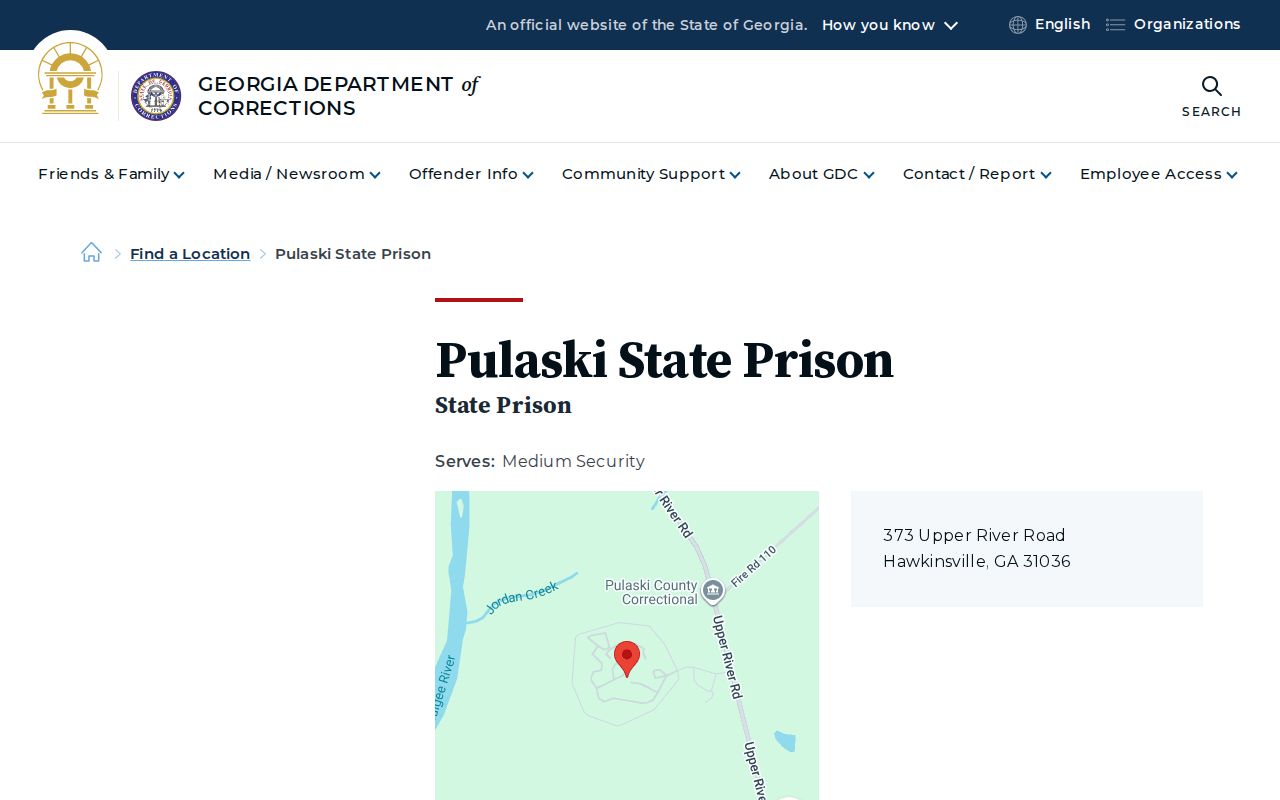
The facility listing establishes which agency controls the prison, so release or discharge questions should follow GDC and parole channels rather than the county jail.
How to Confirm a Pulaski State Prison Release
- Open the GDC offender query and search by name, GDC ID, case number, or available identifying information.
- Match the record carefully. GDC warns that photographs display automatically when available and does not warrant that web information is complete.
- Read the facility and custody information. A current Pulaski State Prison placement means the person remains in GDC custody according to the online result.
- If the person is no longer shown in a GDC facility, check the parolee database when parole is possible. A parolee record indicates release under parole supervision, not sentence discharge.
- Use the parole board's Tentative Parole Month lookup only for possible future parole timing. TPM is not a final release decision.
- Submit a GDC open-records request or seek written verification when an exact release date, release type, facility of release, or discharge status is needed.
Nonappearance in the current-offender query does not prove that the person was never in GDC custody or that every obligation ended. The person could have been discharged, released to parole, transferred, or omitted from the current-facing result. The Pulaski released-inmate search hierarchy helps route state, local, federal, and immigration custody separately.
Pulaski State Prison Records and Contact
Pulaski State Prison
373 Upper River Road
Hawkinsville, GA 31036
Phone: (478) 783-6000
Operator: Georgia Department of Corrections
The facility number is useful for institution-specific routing, but formal release and discharge records should follow GDC's records process. A focused request should include the person's name, GDC ID if known, approximate dates, and the exact fields sought: release date, release type, parole or discharge status, facility of release, transfer information, and non-exempt sentence or discharge details.
GDC says open-records requests should be submitted through its portal. It reports an initial response within three business days, non-medical copy charges of $0.10 each, and possible search or redaction labor billed at the rate of the lowest-paid qualified employee. Those terms apply to GDC, not automatically to Pulaski County offices.
For accuracy, the GDC offender-query terms direct written verification to Inmate Records and Information, P.O. Box 1529, Forsyth, GA 31029. Written verification is the stronger fallback when an online result is incomplete or when the distinction between parole release and full discharge matters.
Projected Release from Pulaski State Prison
Georgia's closest public parole-timing concept is the Tentative Parole Month. The State Board of Pardons and Paroles explains that TPM marks the month when the Board expects to complete final review and may set a parole release date. It is not a promise, final decision, or automatic departure date.
The lookup accepts a six-digit inmate number, GDC ID, or personal data. Use it only for a parole-eligible state prisoner. The Board says most parole-eligible inmates are statutorily eligible after serving one-third of a sentence, but few receive parole at initial eligibility. Eligibility means consideration, not release.
GDC's Performance Incentive Credit program can affect length of stay for eligible people through satisfactory progress in education, vocational work, treatment, work assignments, and good behavior. It does not apply automatically to every sentence. Serious violent felony provisions in O.C.G.A. § 17-10-6.1 and related rules can impose mandatory terms and parole limits. Georgia should not be reduced to a universal “85 percent rule.” The projected release guide explains the correct Georgia terms and confirmation order.
Where Someone Goes After Pulaski State Prison
A state-prison release may lead to parole supervision, another form of community supervision, sentence discharge, or transfer. The parolee database is useful after release for a person under parole. DCS handles community supervision of Georgia parolees and felony probationers, but the legal origin differs: parole follows a Board release from prison, while probation comes from a sentencing court.
For Pulaski-area supervision, DCS lists the Eastman field office as serving Pulaski and the Oconee Circuit. The office is at 351 8th Street South, McRae-Helena, GA 31037, and lists (229) 868-0023 with weekday hours from 8:00 a.m. to 4:30 p.m. The regional location matters because there is not a Pulaski-only supervision office in Hawkinsville.
Parole supervision does not mean the sentence has been discharged. A discharge order, restoration document, or end-of-supervision record may come from the Board, DCS, GDC, or court depending on the case. Ask for the exact record rather than treating a parolee search result as proof that all supervision ended.
About Pulaski State Prison in Hawkinsville
GDC describes Pulaski State Prison as a medium-security facility for adult female felons. It lists visitation from 9:00 a.m. to 3:00 p.m. on Saturdays, Sundays, and state holidays. Visitation information establishes family-contact procedures, but it does not predict or confirm release. Current GDC policies and facility instructions should be checked before any visit.
| Facility fact | Published detail |
|---|---|
| Custody system | Georgia Department of Corrections |
| Population served | Adult female felons |
| Security | Medium security |
| Capacity | 1,223 |
| Opened | 1994 |
| Renovated | 1998 |
These state-prison facts distinguish the facility from Pulaski County Jail, which serves local custody and court processing. The shared county name does not merge the record systems.
Two Hawkinsville Facilities, Two Release Searches
Pulaski County's unusual search problem is the presence of a local sheriff jail and a GDC women's prison in the same community. A person held at Pulaski County Jail may appear as “RELEASED” in the sheriff's arrest-date view. A person leaving Pulaski State Prison is documented through GDC, parole, supervision, and state records. This distinction deserves its own check before any name search begins.
| Question | County jail | State prison |
|---|---|---|
| Who operates it? | Pulaski County Sheriff's Office | Georgia Department of Corrections |
| Primary online route | Sheriff-linked jail report | GDC offender query |
| Release explanation | Jail record and local court | GDC record, parole board, or sentence record |
| After-release supervision | Depends on court sentence or other case | Parolee search and DCS when released to parole |
A GDC result should not be interpreted through bond fields from the county jail report. Conversely, a county bond-out does not require a TPM search unless a separate state sentence exists.
Pulaski State Prison Search Limits and Other Custody
Georgia VINE can provide status or notification information for available records, but coverage depends on participating agency feeds. Treat an alert as a lead and confirm it through GDC or the parole source. Court records may explain sentencing or a later order, while they ordinarily do not replace the GDC discharge record.
BOP and ICE tools are not state-prison release searches. No federal or ICE detention facility was identified in Pulaski County. Use BOP only for federal custody and ICE ODLS only for immigration detention. A transfer out of GDC into another authority is not necessarily release to the community.
When a GDC result is unclear, preserve the GDC ID, case number, facility name, and search date. Those details help Inmate Records and Information distinguish a transfer, parole release, and sentence discharge in a written response.
Match the agency: use GDC for state custody, BOP for federal custody, and ICE ODLS for immigration detention.