
Pulaski Projected Versus Actual Release
A projected date is an estimate, review point, or scheduled date based on current records. The actual release occurs only when the responsible agency completes the release and no other hold keeps the person in custody. Pulaski County Jail and Pulaski State Prison are separate facilities with separate records. The county jail report does not publish a general projected-release field. For state prisoners, Georgia’s closest public parole-timing concept is the Tentative Parole Month.
A pretrial detainee usually lacks a set sentence-release date. Bond may be posted, denied, or changed. A judge may dismiss a charge, enter a release order, impose a sentence, or credit time served. Another county, GDC, ICE, or a federal agency may also hold the person after Pulaski County releases them. A sentenced prisoner can have a calculated term, yet parole review, credits, mandatory minimums, discipline, and later orders can change the timing.
Scheduled versus actual: A TPM, bond amount, sentence end estimate, or projected date is not proof that release has occurred.
Find a Pulaski Release Date
Identify the holding agency before using a locator. A county detainee belongs in the sheriff and court path. A Pulaski State Prison inmate belongs in the GDC and parole path. Federal and immigration custody require federal tools. Mixing them can turn a county transfer into a false claim of release.
- Check the facility. Use the Pulaski jail report for local custody and the GDC Find an Offender page for current state-prison custody.
- For Pulaski County Jail, capture the arrest date, status, days in jail, total bond, charge, and court. Ask the jail or the listed court whether an order, sentence, or hold supplies a date.
- For a parole-eligible state prisoner, open the Board’s TPM lookup information. Search with a six-digit inmate number, GDC ID, or personal data through the linked app.
- Read the result as tentative. Confirm any set parole release date through the Board, GDC, and the current facility.
- Use the sentencing court and agency records when the web result is absent, stale, or unclear.
The official GDC query form also warns that online data may be incomplete and instructs users to verify information in writing with Inmate Records and Information, P.O. Box 1529, Forsyth, GA 31029. That caveat matters most when the person has left the current-custody search.
The GDC source below shows the state offender-query channel and its verification terms.
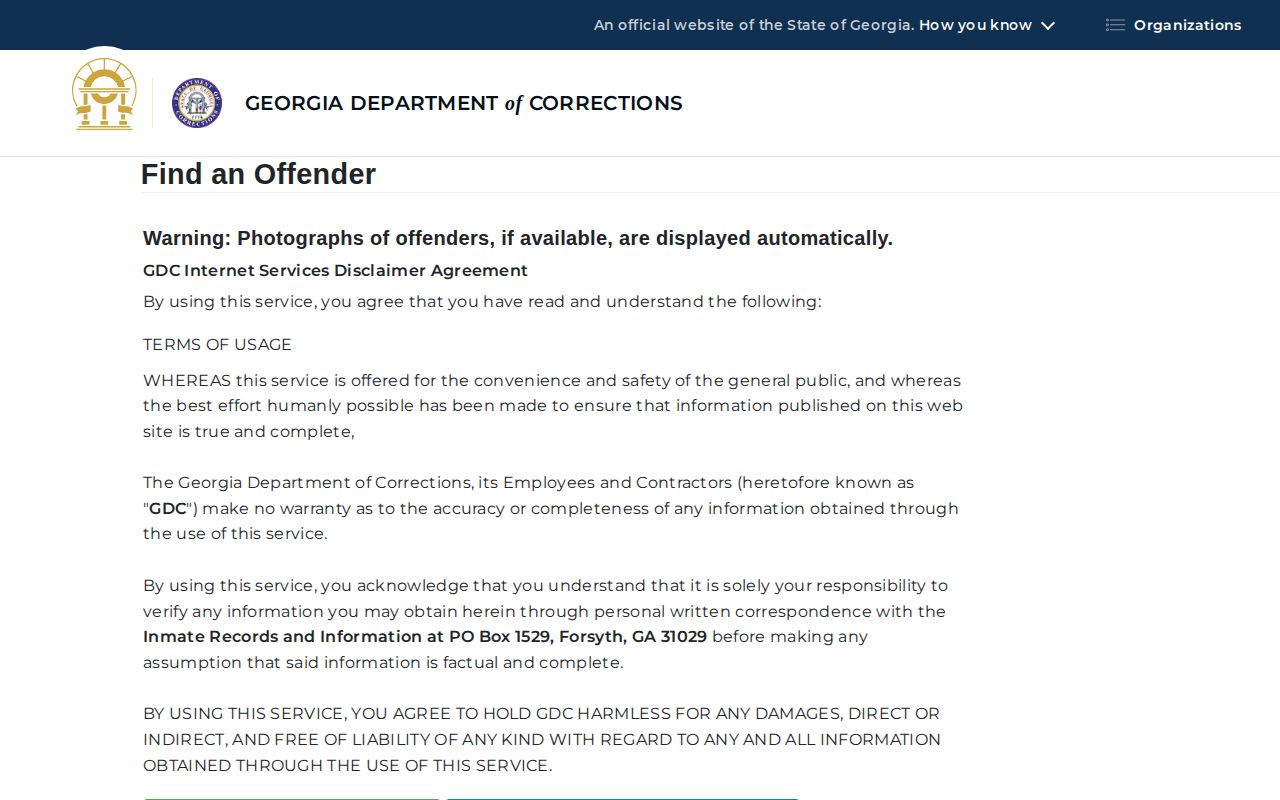
Use it for GDC custody and identifiers, then move to parole or formal records when a released person is no longer shown as current.
Pulaski Jail Release Timing
The Pulaski sheriff-linked report shows arrest date, days in jail, total bond, court, charges, and custody status. It does not show a distinct projected release date for all detainees. “Days in Jail” can help place the current custody event, but it cannot predict when a judge will act, when bond will be posted, or whether another agency will take custody.
For a local sentence, ask Pulaski County Jail for the release date or calculation on the jail record. Then check the controlling court’s sentence, credit for time served, bond order, or later modification. A bond amount is a possible release route, not a release date. A row marked “RELEASED” confirms the local custody status shown online, but the visible row reviewed did not supply the exact release time or reason.
A transfer also ends the Pulaski jail event without ending custody. If the record names another county, GDC, ICE, or a federal agency, that receiving agency controls the next projected date. The Pulaski County released-inmate search explains the full source chain for an event that has already ended.
Note: No official Pulaski jail calculator or general online projected-release field was identified in the reviewed local sources.
Pulaski State Prison TPM
For a person at Pulaski State Prison or another Georgia prison, the Board’s Tentative Parole Month is a key timing field. A TPM is the month when the Board expects to complete final review and decide whether to set a parole release date. It is not a final parole decision. The Board may require good conduct, program completion, or other conditions before release.
The term “tentative” is essential. A person can reach a TPM and remain in prison after denial, deferment, reconsideration, an unmet condition, or a later review. After release on parole, the Parolee Search and DCS supervision channels become more useful than the pre-release TPM lookup.
The Board’s official explanation below sets out what the TPM means.
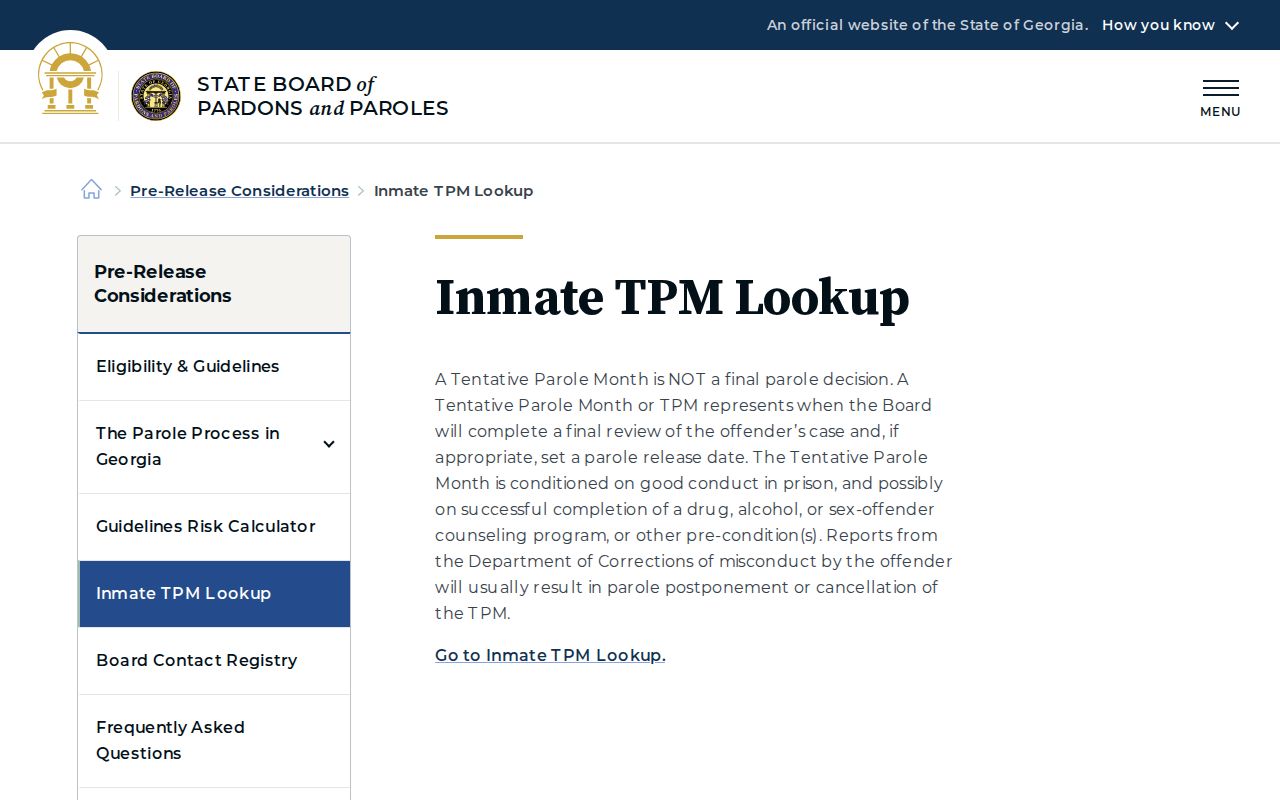
That explanation prevents a review month from being reported as an actual release date.
Pulaski Release Has No 85% Rule
Georgia release timing is not a simple universal “85% rule.” The Board says most parole-eligible inmates become eligible for consideration after serving one-third of the prison sentence. Its parole handbook cites O.C.G.A. § 42-9-45. Eligibility means the Board may consider parole. It does not mean the person will be released at one-third, and the Board reports that few receive parole at initial eligibility.
Serious violent felony sentences can operate very differently. O.C.G.A. § 17-10-6.1 governs listed serious violent felonies and mandatory minimum limits. The parole handbook states that a person serving a term-of-years sentence for a serious violent felony must serve every day and is not eligible for parole. Life-sentence rules and other statutes can create different minimum points before consideration.
The statutory source below illustrates why a generic percentage cannot calculate a Pulaski state-prison release.
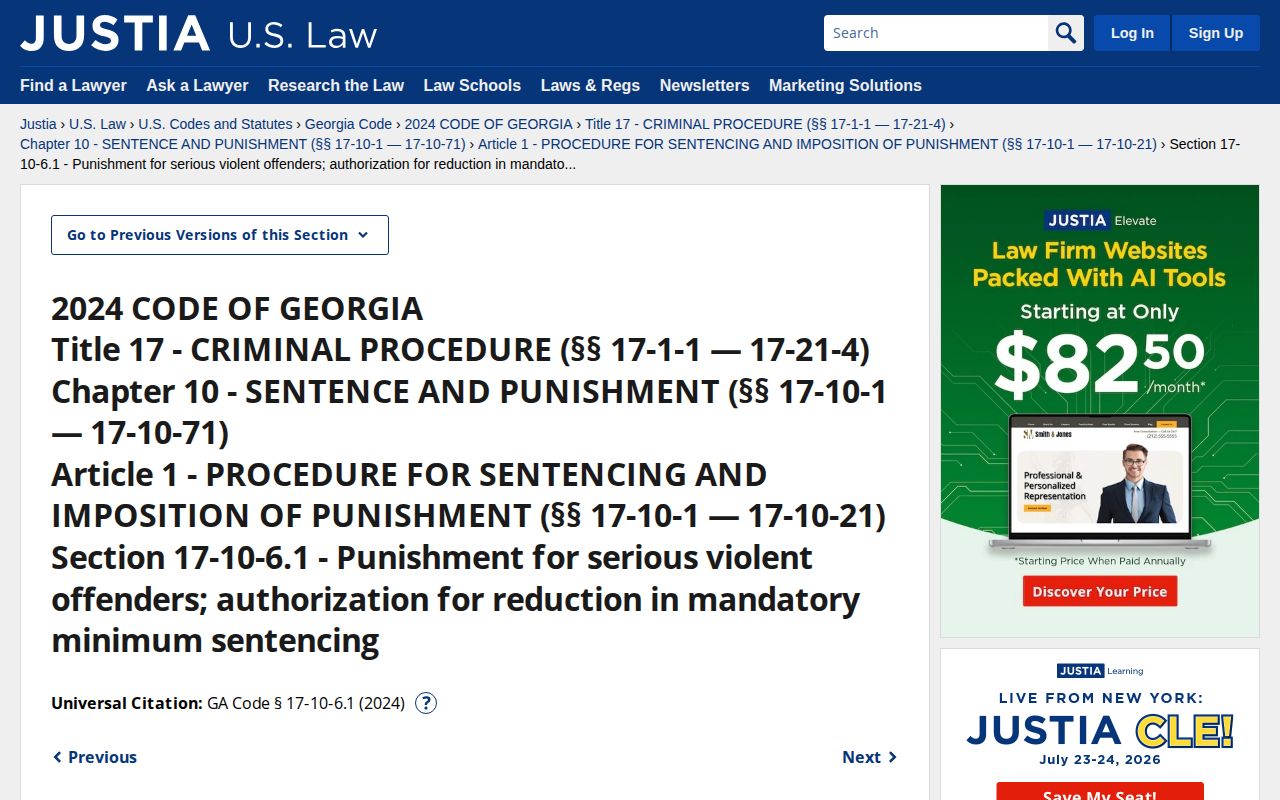
The exact offense, sentence form, mandatory term, and parole eligibility must be read from the court and agency records.
Pulaski Prison PIC Credits
The Georgia Department of Corrections describes its Performance Incentive Credit program as an incentive reentry process for eligible offenders. Satisfactory progress in education, vocational work, treatment, work assignments, and good behavior can reduce length of stay. PIC is a state-prison program. It is not a calculator for a Pulaski County Jail detainee.
PIC also is not automatic for every person or sentence. Eligibility, progress, disciplinary history, sentence restrictions, and Board review all matter. A projected date based on expected credit can move if the person loses eligibility or does not complete a required activity. Conversely, qualifying progress can affect the state’s length-of-stay calculation within legal limits.
The GDC program page below is the official source for the credit framework.
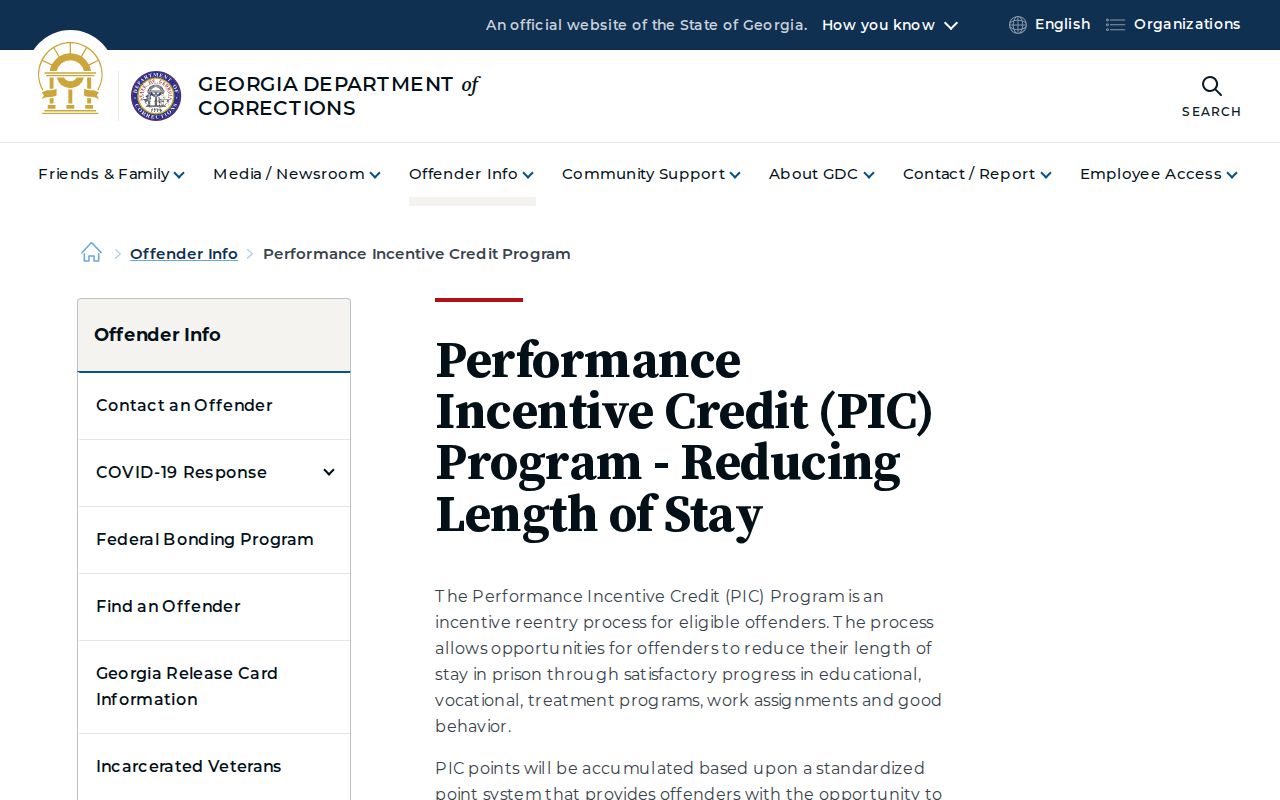
It should be read with the sentence and TPM, not used as a stand-alone release promise.
Pulaski Release Dates Can Change
Projected timing changes when the law, custody facts, or agency calculations change. The cause depends on whether the person is in the county jail, GDC custody, federal prison, or immigration custody. A current estimate is only as sound as the newest order and custody record.
| Factor | Effect on timing | Confirm with |
|---|---|---|
| Bond or court order | May create, cancel, or change a local release path | Pulaski jail and controlling court |
| Hold or detainer | May transfer the person instead of releasing them to the community | Jail and receiving agency |
| TPM review | May result in a set date, deferment, denial, or later review | State Board of Pardons and Paroles |
| PIC or discipline | May alter eligible state-prison length-of-stay credit | GDC and current facility |
| Sentence change | May add credit, probation, revocation, or a new term | Sentencing court |
| System lag | Web data may trail an agency action | Agency records office |
A detainer is a request or legal basis for another agency to take or keep custody. It can make a local “release” a transfer. Revocation is the withdrawal of parole or probation after a violation process and may return someone to custody. These terms should never be treated as routine release to the community.
Pulaski Release Source Hierarchy
Use the agency that controls the custody. Pulaski County Jail and the local court control local timing. GDC, the Board, and DCS control state-prison, parole, and community-supervision records. The Bureau of Prisons controls federal sentence calculations. ICE controls current immigration detention records.
- County jail: jail release record, bond or sentence order, and court docket.
- State prison: GDC custody data, TPM, parole decision, PIC status, and GDC open records.
- Federal prison: BOP Inmate Locator, which can show a future projected federal release date.
- Immigration custody: ICE Online Detainee Locator for current covered custody, followed by the responsible field office when no result appears.
- Missing or stale result: written records request to the responsible agency and the sentencing court.
A BOP status of “Released” or “Not in BOP Custody” ends only the BOP custody statement. An ICE transfer similarly may follow a county release. Each new custodian must be checked before describing the person as out of all custody.
Confirm Pulaski Actual Release
Close the search with a direct record. For a local detainee, ask Pulaski County Jail for the release date, time, reason, and any transfer destination, then compare the court order. For a state prisoner, use GDC records, the Board’s parole status, and DCS when community supervision follows. GDC’s Open Records Request portal states that it provides an initial response within three business days, charges $0.10 per non-medical copy, and may charge qualified search or redaction labor.
Georgia VINE can add a custody-change alert if registration occurred and the agency participates. It does not replace the release log, discharge record, or court disposition. The Pulaski VINELink inmate search explains how to register and how to confirm an alert.
Ask for the narrow record that answers the question. Useful fields include the release date and time, release type, releasing facility, transfer destination, sentence or parole status, and supervision after release. If an agency withholds part of the record, request the non-exempt portions and the legal basis for any redaction.
Note: Recheck the responsible agency after any new court order, transfer, parole review, or custody alert changes the expected date.