
Pulaski Parole and Probation
Parole and probation can both place a person under Georgia Department of Community Supervision oversight, but they start in different ways. The State Board of Pardons and Paroles decides parole for an eligible state prisoner. A Pulaski County court orders probation as part of a sentence. Someone who bonded out of Pulaski County Jail is not automatically on either form of supervision. The court docket, Board record, or DCS information must show it.
The source distinction matters. Pulaski State Prison is a GDC facility, so release from that prison may lead to parole. A local jail release after bond, dismissal, time served, or transfer does not by itself create parole. Felony probation may still follow a Pulaski sentence, including a split sentence that combines confinement and probation.
Supervision also differs from custody. A parolee or probationer may live in the community while reporting to DCS and following the terms of an order. A person can also be held in jail on an alleged violation while the Board or court decides the case. The live jail roster answers the custody question at that point. It does not state the final supervision outcome. Matching the date and case across the jail, court, Board, and DCS records avoids treating an arrest on a violation as an automatic revocation.
| Question | Parole | Probation |
|---|---|---|
| Who creates it? | State Board of Pardons and Paroles after prison review | Sentencing court in the criminal case |
| When does it begin? | After release from state prison on parole | As ordered by the court, with or without prior confinement |
| Best status source | Parolee Search, Board records, and DCS | Court docket, probation order, and DCS |
| Local service path | DCS Eastman Field Office serves Pulaski and the Oconee Circuit | |
- Parole
- Conditional release from prison under Board authority.
- Probation
- A court-ordered sentence served under set terms in the community.
- Discharge
- The formal end of a sentence or supervision term.
- Absconder
- A supervised person alleged to have stopped reporting or left supervision without permission.
Check Pulaski Post-Release Supervision
Start with the kind of custody the person left. The Board’s tools apply to a Georgia state prisoner or parolee. A Pulaski County Jail row marked released may instead reflect bond, a court order, time served, dismissal, or transfer. For that local event, use the court named in the jail charge table and request the release record when the exact outcome is unclear.
- Check the Georgia Parolee Search for a person believed to be on parole. Partial terms can return matching parolee records, so compare identifiers.
- For someone still in GDC custody, use the TPM explanation and lookup path. A Tentative Parole Month is review timing, not proof of release.
- For probation, read the Pulaski sentencing docket and probation order. The Pulaski County Clerk of Court is the local path for the proper court record.
- Confirm which DCS field office serves the case. The Eastman office lists Pulaski and the Oconee Circuit among its service area.
- If online data conflicts, ask the Board, DCS, or sentencing court for the official status and discharge record.
Nonappearance does not prove that supervision never existed. A person may have completed supervision, may be supervised through a different office, or may have a court status not reflected in a public search. The full Pulaski County release search and records path is on the home page.
Use names with care when a search returns several records. Compare the GDC identifier, court case, facility, sentence details, and any dates shown by the official source. The parolee database can return records containing a partial search term, so a name match alone is weak proof. If the person is not in the parole search, check whether probation rather than parole is involved. The Pulaski court order should state the term and whether DCS supervision applies.
Important: A TPM, eligibility date, or released jail status does not establish that a person is currently on parole or probation.
Pulaski Supervision Uses Eastman
Pulaski does not have a Pulaski-only DCS office listed in Hawkinsville. The regional DCS Eastman Field Office serves Pulaski, the Oconee Circuit, and several nearby counties from McRae-Helena. That office is the practical contact for local field-supervision routing after a person returns to the Pulaski area on parole or felony probation.
The office can clarify the proper supervision contact, but it does not replace the Board’s parole decision or the court’s probation order. Those records remain the legal source. When contacting DCS, provide enough details to distinguish the correct person and ask which public channel can confirm current supervision or discharge.
Georgia DCS Eastman Field Office
351 8th St. South
McRae-Helena, GA 31037
Phone: (229) 868-0023
Fax: (478) 374-6829
Monday-Friday, 8:00 a.m.-4:30 p.m.
The official DCS location page below shows the regional office and its Pulaski service area.
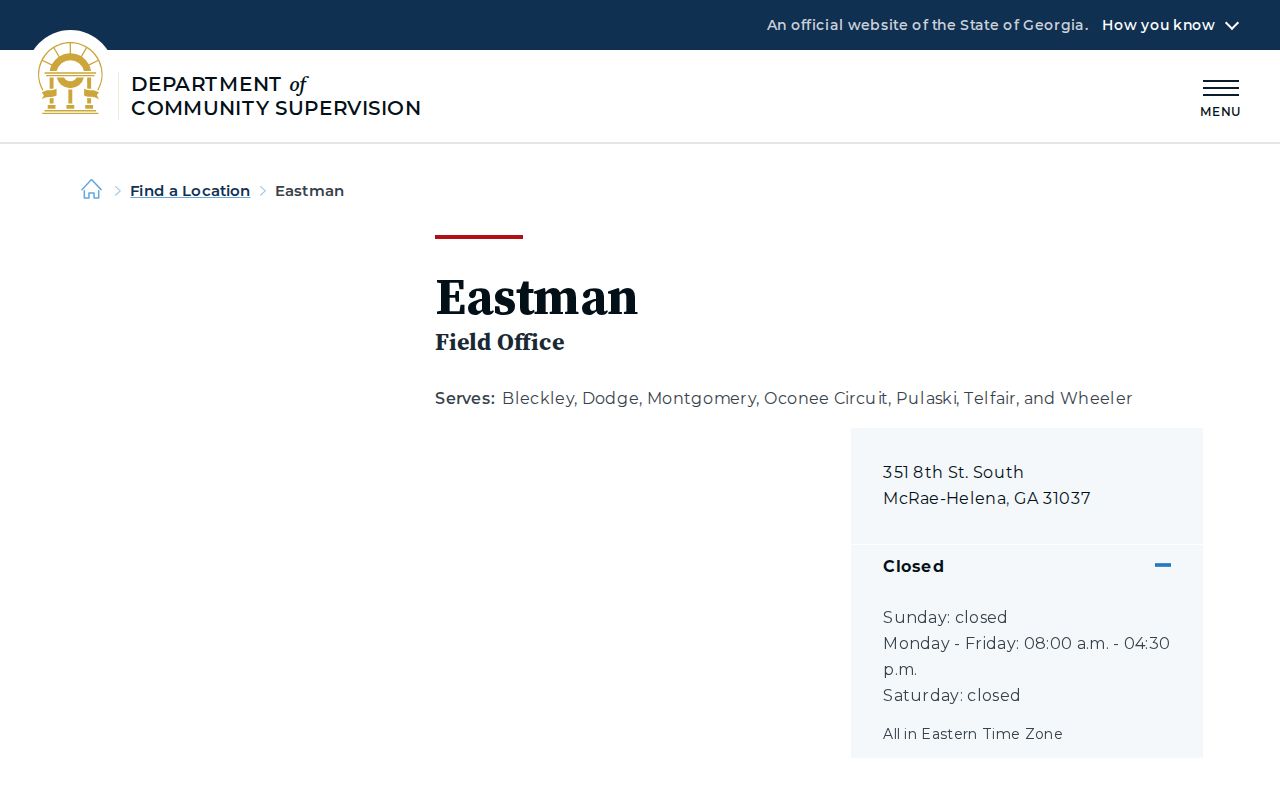
This regional listing explains why a Pulaski supervision contact is located outside Hawkinsville.
Note: Office hours and assignments can change, so confirm the current contact before traveling to the Eastman field office.
Pulaski Parole Review Records
The Board separates pre-release review from after-release supervision. Before release, its TPM lookup can show when final file review is expected. The Board says a TPM is tentative and may be conditioned on good conduct and program completion. At final review, the Board may set a parole release date, defer action, deny parole, or schedule later reconsideration under its rules.
Most parole-eligible Georgia inmates are statutorily eligible after serving one-third of the prison sentence, according to the Board’s parole process. Eligibility only allows consideration. It does not promise release at that point, and the Board says few people receive parole at initial eligibility. O.C.G.A. § 42-9-45 supplies the general rule cited in the parole handbook, while serious violent felony sentences can have much stricter limits under O.C.G.A. § 17-10-6.1.
The official parole-process source illustrates the distinction between a point of eligibility and an actual release decision.
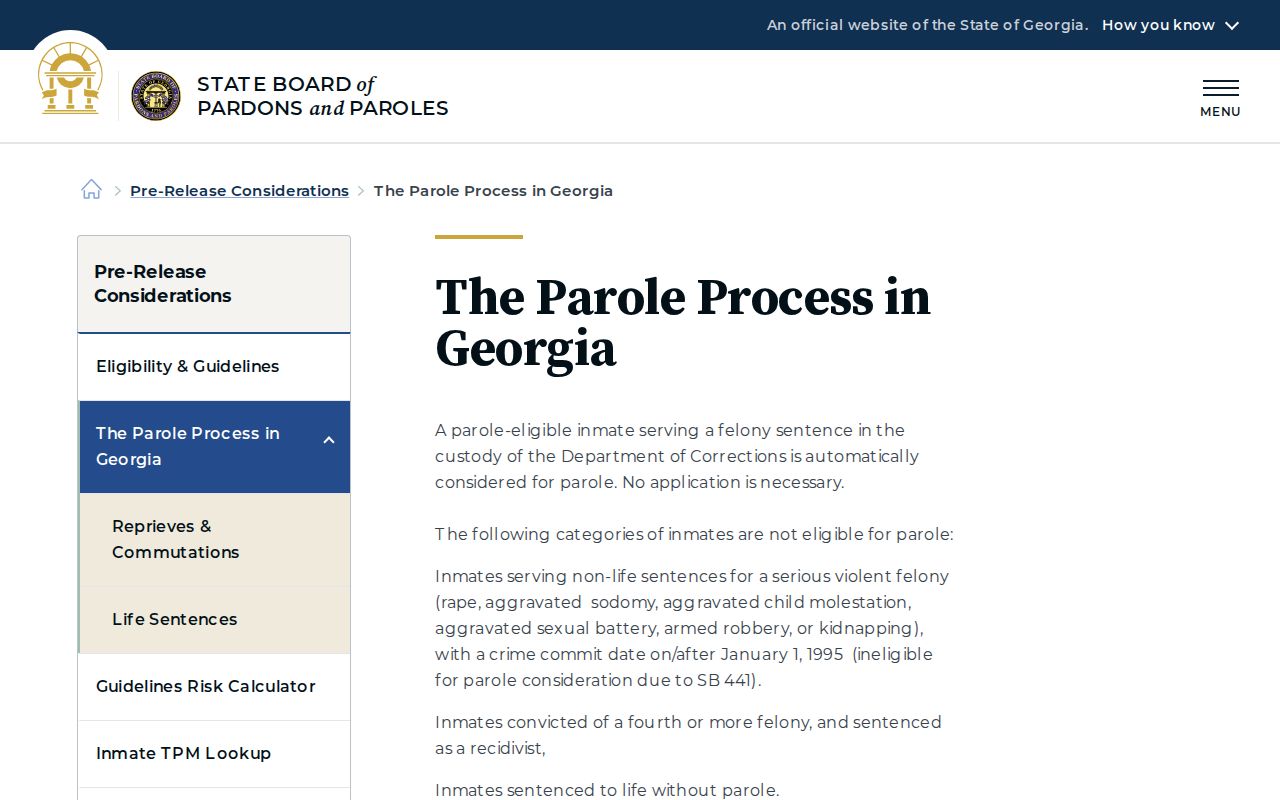
Use that process record with TPM and parolee results, not as a stand-alone release date.
Pulaski Parole Meeting Sources
Georgia does not publish an ordinary county-by-county inmate parole hearing calendar for Pulaski. The Board posts public monthly meeting notices and agendas through its press-release index. Those notices describe Board operations meetings. They are not a list of individual Pulaski release decisions.
For one person, use TPM before release and Parolee Search after release. Meeting agendas can add public Board context, but they should not be read as a missing-person result. A published January 2026 notice cited O.C.G.A. § 50-14-1 and identified a monthly public meeting at the Board’s Atlanta hearing room.
The Board’s official notice below demonstrates the meeting-level record that is publicly posted.
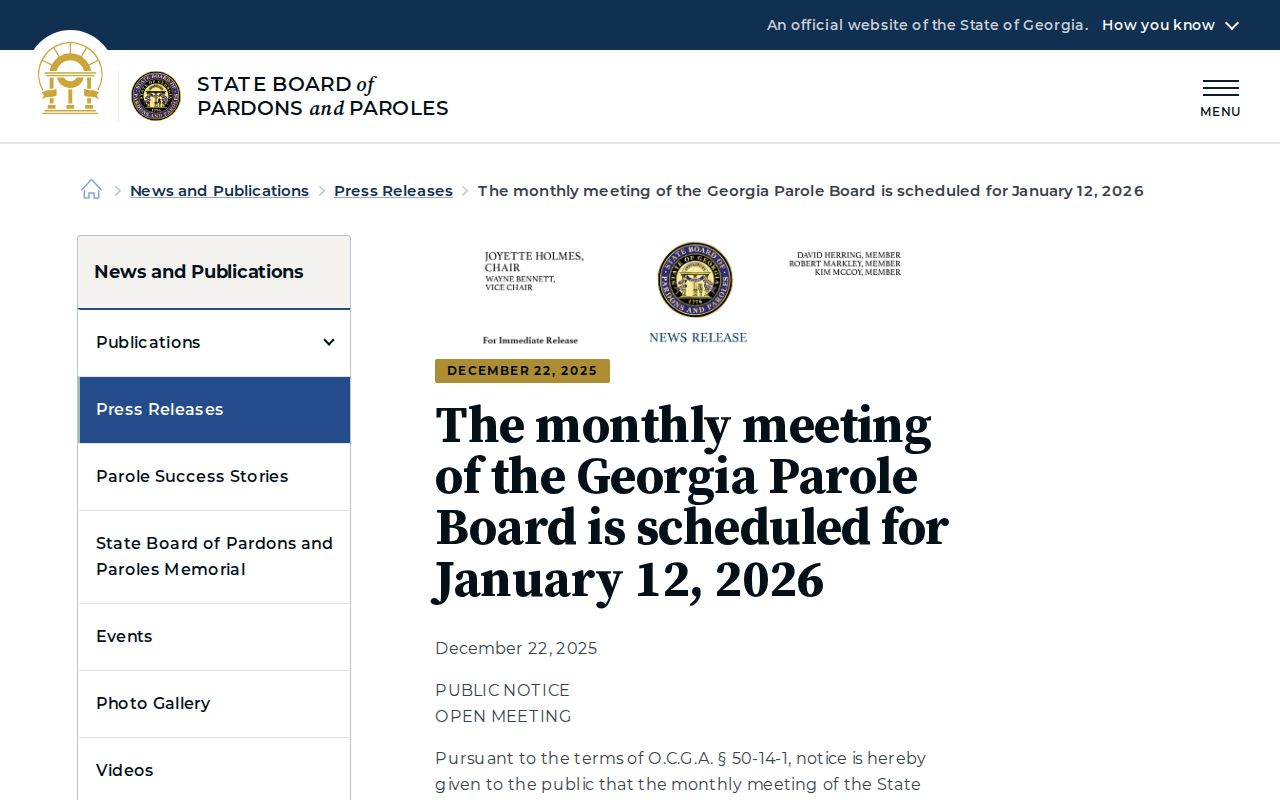
It supports a monthly public-meeting source, not an individual parole hearing docket.
Pulaski Supervision Violations
A violation means an alleged breach of a supervision term. It does not by itself prove a final revocation. DCS, the Board, or the court determines the next action based on whether the case is parole or probation. Possible records include a warrant, violation report, court filing, sanction, revocation order, or a new jail booking.
Conditions vary by order and person, so no generic list can establish compliance. The controlling parole certificate, probation sentence, and later modifications supply the actual terms. DCS handles field contact and monitoring, while the Board retains parole authority and the court retains probation authority. Questions about a missed report, travel limit, payment, treatment term, or alleged violation should go to the assigned office or counsel, not be inferred from a public search result.
No Pulaski-specific public absconder list was found in the official sources reviewed. If a supervised person is arrested on a violation, the Pulaski jail report may show a current booking and a probation-violation charge. If the person remains in the community, DCS and the controlling court or Board are the better sources. An absconder label describes an alleged failure to remain in contact; it is not the same as release, discharge, or proof of a new conviction.
Georgia VINE may provide a custody-change notice when an arrest or release is in a participating feed. It is not a supervision ledger. Confirm the legal status through the agency that imposed or manages the supervision.
Pulaski Supervision Discharge Records
Supervision ends through a formal discharge, sentence completion, court order, or other authorized action. A parole discharge is tied to Board and DCS records. A probation discharge is tied to the sentencing court and DCS. Simply reaching an estimated end date does not prove that every condition has been met or that the agency has entered a discharge.
Ask for the record that matches the source. For parole, request the Board or DCS record showing discharge or current status. For probation, obtain the Pulaski court docket and discharge order when one exists. If a violation or revocation changed the term, the later order controls. This source-first method also prevents a county jail release from being mistaken for the end of state supervision.
Board and DCS records may show different stages of the same case. The Board controls the parole decision, DCS handles field supervision, and the court controls probation. Reading all three roles keeps Pulaski County parole and probation verification precise.