
Understanding Pulaski County Releases
“Released” means one agency has ended its custody, but it does not always mean the person is free of all legal control. A Pulaski County Jail detainee may post bond, finish a short sentence, receive a court order, move to probation, or transfer to another agency. A Pulaski State Prison inmate may leave on parole, reach sentence discharge, or transfer within the Georgia Department of Corrections. Each event creates a different record. The sheriff and jail control local custody facts. GDC controls state-prison records. Courts explain the order or sentence, while the State Board of Pardons and Paroles and the Department of Community Supervision document some post-release supervision.
A name normally vanishes from a current-custody roster after the person leaves that facility. That change is a useful clue, not proof of release to the community. The Pulaski jail may have transferred the person to GDC, another county, federal authorities, or immigration custody. The sheriff-linked Inmates by Arrest Date view is more useful than the current list because it can retain a row marked “RELEASED.” Exact cause, time, and receiving agency may still require the jail record or court file.
Pulaski County Release Types
The status word alone rarely tells the full story. Match it to the court, charge, bond field, and releasing facility. “Time served” means the court credited enough confinement to satisfy a jail term. A transfer ends Pulaski custody but starts or continues custody elsewhere. Parole is conditional release from state prison; probation is a court-ordered sentence served in the community, sometimes after a split term.
| Release path | What it means | Best next record |
|---|---|---|
| Bond | The person leaves local custody after bond conditions are met. | Jail release log and the case docket |
| Time served or court order | A judge's order ends the local confinement period. | Court disposition and jail record |
| Probation | The sentencing court orders community supervision. | Court order and DCS when it is felony supervision |
| Parole or discharge | A state prisoner leaves under Board authority or completes the sentence. | Parole tools, DCS, GDC records |
| Transfer or detainer | County custody ends, but another agency takes control. | Receiving agency, BOP, ICE, GDC, or another jail |
A dismissed charge may lead to release, yet only the court file proves the dismissal. Death in custody is also an end-of-custody event but must never be described as an ordinary release. When the online row lacks a reason, request the official release entry rather than infer the cause from bond or days in jail.
Pulaski County Release Record Fields
The online jail report is a booking-oriented view, not a full discharge certificate. It shows enough detail to identify a person and route the next inquiry. The arrest-date results reviewed included mixed “RELEASED” and “CURRENTLY BOOKED” statuses. Its arrest date is not the release date, and “days in jail” is not a substitute for a timestamp. Capture the row details before contacting the agency because they help staff locate the correct booking.
| Field | What it establishes |
|---|---|
| Name and descriptors | Help distinguish people with similar names; the displayed address was redacted. |
| Status | Separates a released row from one still marked currently booked. |
| Arrest date and days in jail | Describe the custody period but do not prove the exact release time. |
| Total bond | Shows an amount or a label such as not set or denied; it does not prove bond was posted. |
| Warrant, count, and statute | Provide case clues for the jail or clerk. |
| Charge and court | Point to the court file that may explain bond, dismissal, sentence, or transfer. |
| Facility and release details | Exact release time, reason, destination, and authority may exist only in the formal jail record. |
Request Pulaski County Release Records
For a county-jail record, contact the Pulaski County Sheriff's Office or Pulaski County Jail at 34 Badge Boulevard, Hawkinsville, GA 31036, phone (478) 783-4011. The local sheriff page does not publish a separate online release-record request form or a Pulaski-specific copy schedule. Georgia's Open Records Act still governs access. Ask for the narrow record needed and request a cost estimate before work begins. A state-prison discharge record goes instead through the GDC Open Records Request portal.
- Identify the person with full name and any known booking, GDC, warrant, arrest-date, or case number.
- Name the record precisely, such as the jail release log entry, release date and time, release reason, or receiving agency.
- Give a useful date range and the facility. This reduces search time and false matches.
- Ask whether any portion is withheld and request the legal basis for each redaction.
- Keep the agency response with the court disposition when the reason for release matters.
GDC says it provides an initial open-records response within three business days. It lists nonmedical copies at $0.10 per page and permits qualifying search or redaction labor charges. Those GDC terms should not be presented as the county jail's fee schedule. Georgia public agencies may provide records, state when they will be available, or identify exemptions. A sealed, restricted, juvenile, medical, or security-sensitive portion may not be public.
Georgia Law on Pulaski Records
O.C.G.A. § 50-18-70 states Georgia's broad policy favoring access to public records. Section 50-18-71 addresses inspection, response timing, and costs, while Section 50-18-72 contains exemptions. The research did not identify a fixed online retention period for Pulaski's arrest-date rows. Recent released entries may remain searchable, but a missing row should be pursued through the jail and court rather than treated as proof that no record exists.
Georgia commonly calls expungement “record restriction.” Restriction can limit what appears in public channels, but it does not mean every agency record is physically destroyed. The sheriff page links to the GBI restriction path. Corrections, court, and supervision agencies may also retain records under their own schedules. Corrections or restriction questions belong with the agency that created the entry and the court that handled the case.
Find Released Pulaski County Inmates
Start with the custody system, not a broad name search. Pulaski has both a county jail and a GDC state prison. A local arrest usually starts with the sheriff-linked jail report. A sentenced state prisoner belongs in GDC, parole, and DCS channels. Federal and immigration cases use separate locators.
- Check the current Pulaski jail report. A “CURRENTLY BOOKED” row means the person remains in that local online population.
- Open Inmates by Arrest Date, set a reasonable range, and read each status. Do not confuse the Jail Releases: 24 Hours workaround with the site's 24-hour arrests feed.
- For Pulaski State Prison or another GDC facility, use GDC tools and the Board's TPM or parolee records. Use Projected Release for the limits of those date fields.
- Use the court label and charge clues to find the disposition. A release status says custody ended, while the order may explain why.
- Check Georgia VINE if a person-specific notification was registered, or the parolee database when state parole applies.
- Use BOP for a federal sentence and ICE ODLS for immigration detention. Then request the official record if the online trail is incomplete.
GDC Search for Pulaski Releases
The GDC Find an Offender page is designed chiefly for people currently in a GDC facility. The direct query allows searches by description, name, ID, or case number, but GDC warns that online information is not guaranteed complete and directs written verification to Inmate Records and Information, P.O. Box 1529, Forsyth, GA 31029. Do not oversell that current-offender tool as a complete archive of every released Georgia prisoner.
| Search input | Use |
|---|---|
| GDC ID | Best precise match when known |
| Name | Broader match that needs identity checks |
| Description | Helps narrow records when supported |
| Case number | Connects a state corrections result to a case |
After state custody, use the Board's parolee database for someone on parole, DCS for supervision routing, the sentencing court for sentence and probation orders, and GDC open records for a formal release or discharge record. A county-only bond release will usually not become a GDC offender record.
Read Pulaski Jail Release Status
Pulaski does not publish a distinct official feed of people released in the past day or three days. Its “24 Hours Arrests” tab is explicitly a booking view. The arrest-date page is the practical released-person tool because it has date controls, pagination, and mixed statuses. It does not show a separate release timestamp in the visible fields reviewed. Read “RELEASED” as a custody-status lead, then confirm the exact event with the jail or court.
No formal update cadence is promised. Court orders, bond processing, weekends, transfers, and data entry can create delays. The Jail Releases: 72 Hours method explains how a wider arrest-date range works without pretending it is a true release-time feed.
Pulaski Parole and Probation Checks
Parole and probation have different legal sources. The State Board of Pardons and Paroles decides parole and provides TPM and parolee tools. A sentencing court orders probation. Georgia DCS supervises parolees and felony probationers in the community. Its Eastman field office serves Pulaski and the Oconee Circuit from McRae-Helena. Check Probation & Parole for the office route, search limits, and parole terminology.
- Parole
- Conditional release from state prison by the parole board.
- Probation
- A court sentence served under conditions in the community.
- Discharge
- The end of a sentence or supervision term, confirmed by the responsible agency.
- Detainer
- A request or legal basis for another agency to take custody.
Pulaski Release Alerts and Transfers
Georgia VINE provides custody-status and criminal-case information plus registration for notifications. It is a notification layer, not Pulaski's permanent jail archive. Coverage depends on agency feeds. A release alert should be confirmed through the jail, GDC, or court when the precise reason or time matters. The state service lists 1-833-216-6670.
A federal sentence belongs in the BOP Inmate Locator, which covers federal inmates from 1982 forward. “Released” or “Not in BOP Custody” means the person is no longer held by BOP, not that no other supervision or custody exists. ICE ODLS covers current ICE detention and certain recent CBP custody. Release from the Pulaski jail to ICE is a transfer out of county custody, not release to the community.
Compare Pulaski Release Sources
Use the source whose jurisdiction matches the custody event. The same person can move through more than one row over time.
| Source | Best for | Limit |
|---|---|---|
| Pulaski current jail report | Current county custody | A released name usually drops away |
| Arrest-date view | Recent local rows marked released | No separate release timestamp seen |
| Jail record and court file | Release reason, order, and case outcome | May require a direct request |
| GDC, Board, and DCS | State prison, parole, and felony supervision | Not the normal county bond-out trail |
| BOP or ICE | Federal or immigration custody | Separate from sheriff records |
Two Pulaski Release Systems
Pulaski County Jail is operated by the sheriff and holds local detainees. Its release trail begins with the jail report, the jail record, and the court connected to the charge. Pulaski State Prison is a GDC medium-security prison for adult women. Its releases follow GDC, parole, DCS, and state-record channels. GDC lists the prison at 373 Upper River Road in Hawkinsville and reports a capacity of 1,223. A state-prison release should never be described as a county-jail release merely because both facilities are in Pulaski County.
The distinction is the key local fact. Ask which facility held the person on the last day of custody. That answer determines whether the sheriff, GDC, a court, or a receiving agency owns the release record.
Mixed Pulaski Release Results
The Pulaski arrest-date page mixes released and currently booked people in one result set. During the research review, several rows showed “RELEASED,” while another on the same results page showed “CURRENTLY BOOKED.” The date filter therefore describes arrest dates, not a common release status or release window.
Read every status line. Then save the court label, statute, warrant clues, arrest date, and charge text for the correct person. Those details make the next call or court search far more precise and reduce the risk of confusing two people with similar names.
Does Pulaski Bond Prove Release?
No. The jail report's Total Bond field can show a dollar figure, “NOT SET,” or “DENIED,” but the field describes bond information rather than the final act of release. A stated bond may not yet have been posted. Conditions, holds, paperwork, or another charge can also keep a person confined.
Confirm a bond-out through the release status and jail record. Then use the named court to understand the continuing case. A transfer, time-served order, dismissal, or later state-prison release follows a different path even if the booking row also contains bond data.
Pulaski Court Fields Explain Release
The court field in each Pulaski charge table is the bridge between jail status and case outcome. The report can name Magistrate, Probate, Superior, or another court label. Capture that label with the statute and warrant or case clues. For felony matters, the GSCCCA Pulaski clerk listing identifies the Superior Court clerk at 141 Commerce Street in Hawkinsville, phone (478) 783-1911, open weekdays from 8:00 a.m. to 5:00 p.m.
The Georgia court e-access page routes users to provider sites and warns an account may be required. The clerk remains the direct route when the online provider fails. A court file may show bond, dismissal, nolle prosequi, plea, sentence, probation, revocation, or completion. It often explains what the short jail status cannot.
The statewide court-access screen illustrates that provider route. Open the official Georgia Courts entry page before choosing a case-search provider.
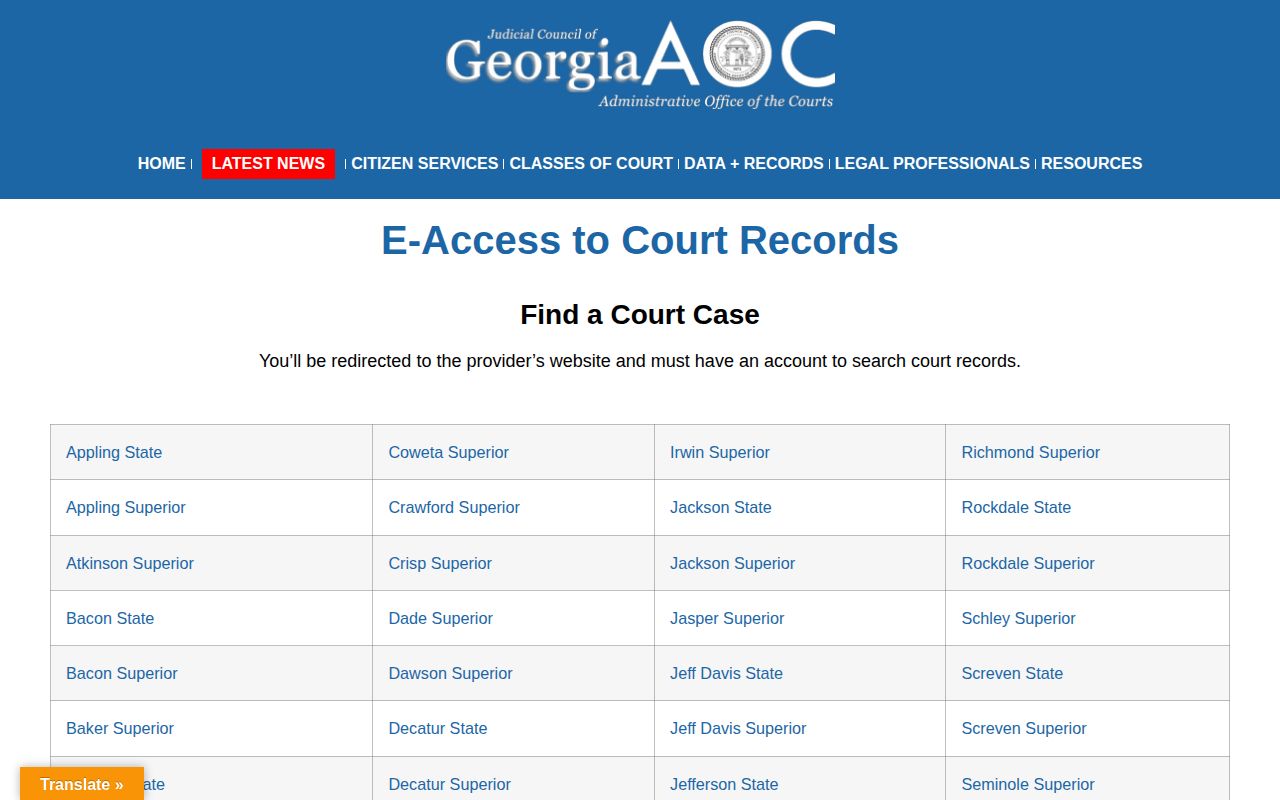
Use the court named in the jail row, since the statewide entry point does not itself decide which Pulaski court holds the disposition.
Pulaski Federal Release Status
No dedicated BOP, ICE, or U.S. Marshals detention facility was identified in Pulaski County. Still, a local detainee may leave sheriff custody for federal authorities. The county record should establish that transfer; the federal docket, Marshals case path, BOP locator after designation, or ICE ODLS then becomes the next source.
BOP explains its result wording on the official locator. Review the BOP status explanation when a federal result says released or not in BOP custody.
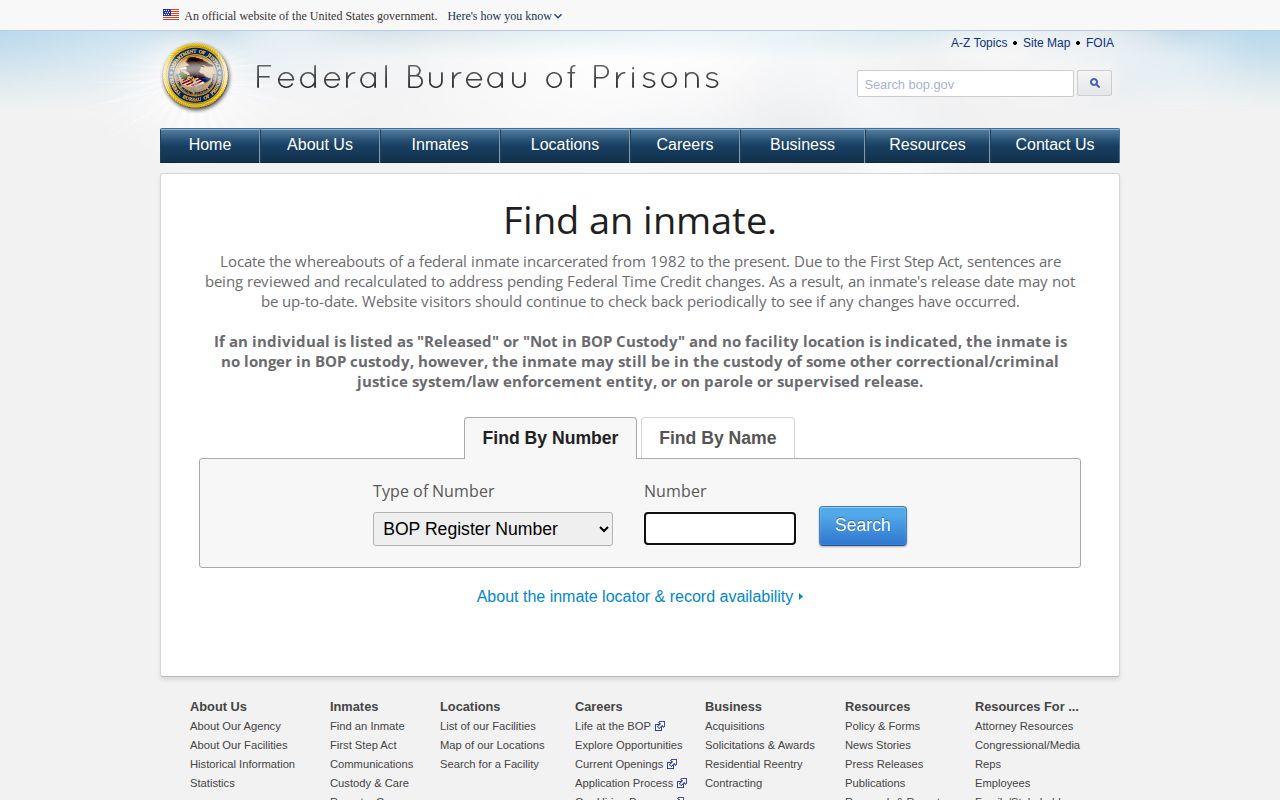
That status closes only the BOP custody question. It does not rule out supervised release, another jail, state custody, or immigration detention.